ALBEDO
The following data is from a 2021 publication entitled “Earth’s Albedo 1998–2017 as Measured From Earthshine”, http://P. R. Goode, E. Pallé, A. Shoumko, S. Shoumko, P. Montañes-Rodriguez, S. E. Koonin
The object of this article is to test the validity of albedo data measured by earthshine against data acquired from the CERES program where albedo is measured by radiometer equipped satellites. Earthshine is the light reflected from earth to a darkened part of the moon which is reflected back to earth and measured at night. The result of the test was that the earthshine method followed CERES data reasonably well per the graph below. The value of the publication to this study is the CERES data.
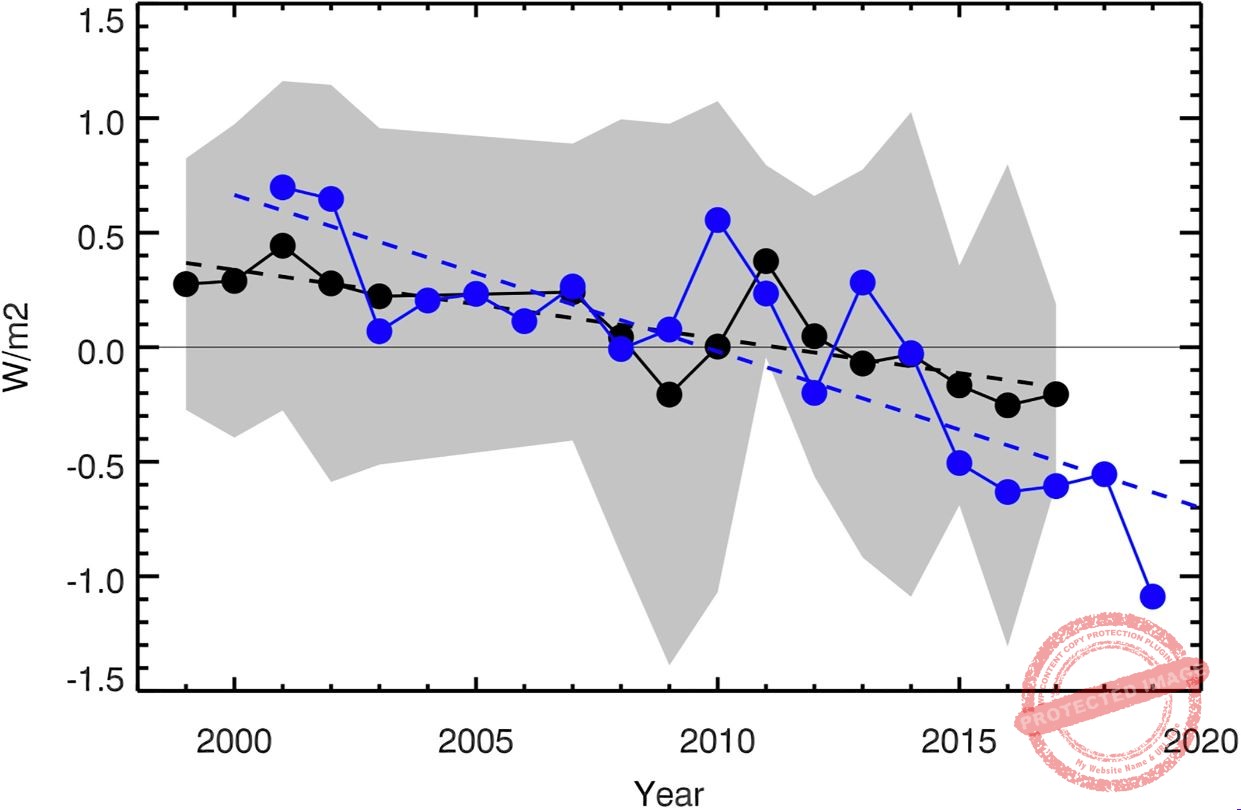
Earthshine annual mean albedo anomalies 1998–2017 expressed as reflected flux in . The error bars are shown as a shaded gray area and the dashed black line shows a linear fit to the Earthshine annual reflected energy flux anomalies. The CERES annual albedo anomalies 2001–2019, also expressed in , are shown in blue. A linear fit to the CERES data (2001–2019) is shown with a blue dashed line. Average error bars for CERES measurements are of the order of 0.2 .
CLIMATE FORCING
Climate forcing is the energy required as heat to raise earth’s global average temperature (also measured by satellite) to main the balance of solar energy absorbed by earth less that reflected by albedo back to space.) This why albedo is also given the units of watts/m2 . For example: if earth albedo is 0.30, then the energy reflected to space is 0.3 * 1367 watts/m2 = 410 watts/m2. The remainder that solar energy is absorbed by the earth (and lower atmosphere) being
(1367 – 410) watts/m2 = 957 watts/m2, which must be forced to space by raising earth’s surface temperature. NOTE: Temperature increases will vary over the earth depending on latitude, surface reflectivity, angle of incidence of sunlight, time of year and day, etc. These factors also affect localized absorption of sunlight. Remember earth’s surface is 70% water.
TEMPERATURE