This website is a work in progress. Comments and suggestions are welcome.
 Me in 1971
I, Calvin M. Wolff, repent believing that global warming would be much smaller than it actually is if computed only by the greenhouse effect.
A good introduction to earth albedo is from NASA: https://mynasadata.larc.nasa.gov/basic-page/albedo-values: https://mynasadata.larc.nasa.gov/basic-page/albedo-values
BOTTOM LINE ON TOP: A 0.01 reduction in earth’s albedo (approx. 0.3) will result in a rise of approximately 0.92C in earth’s global annual average temperature. The greenhouse effect will add to the increase.
This the result of the analysis of a simple heat balance analysis based on solar energy in and heat rejected out from earth to space. The greenhouse effect is part of the circuit that loses the heat. That is to be added to the 0.92C increase.
EARTH ALBEDO is the major player. Earth Albedo is the ratio of sunlight incident on the earth to that reflected back to space. Earth albedo has been typically 0.3, meaning that 30% of sunlight striking earth is reflected back to space – also meaning that the remaining 70% of the sunlight is ABSORBED by earth. Albedo is the same as “reflectance” [r “reflectivityTo maintain a constant average global surface temperature the earth must return the absorbed solar energy back to space. This returned energy ultimately is infrared light emitted to space through the atmosphere. In order to maintain this balance the EARTH’S TEMPERATURE HAS TO RISE! The GREENHOUSE EFFECT magnifies this effect by RETARDING the rate of energy flow from earth’s surface to space. Figure 1 below depicts these phenomena.  Figure 1 “Long Wave Radiation” means infrared radiation. “Short Wave Radiation” means, in this case, mostly visible radiation, with some ultraviolet and infrared radiation.
The electrical equivalent of the greenhouse effect is: temperature is voltage, heat flow is current, the greenhouse effect is resistance. In order to maintain constant current the voltage (temperature As tbe resistance increases the voltage (temperature) must increase.
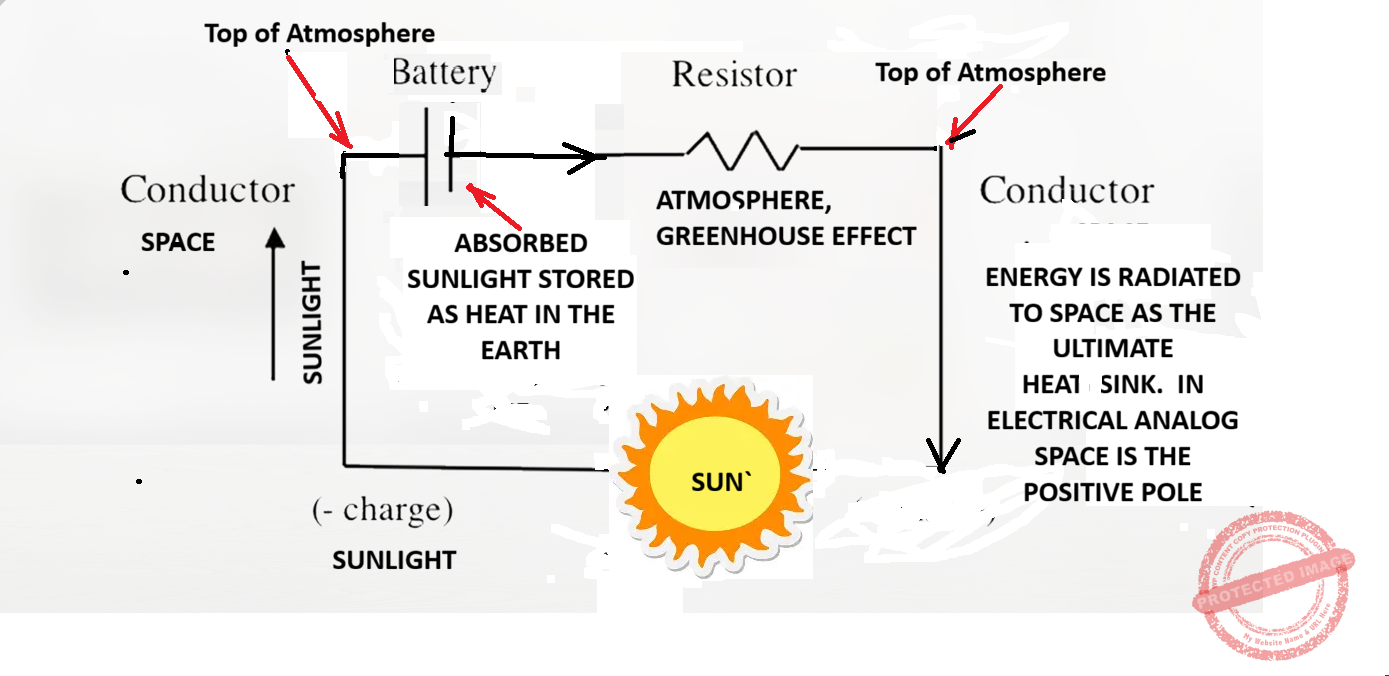
Figure 2 Electrical Analog of Heat Balance. The sun is powered by fusing hydrogen atoms into helium atoms. There is a plentiful but limited supply of hydrogen in the sun. Billions of years worth.
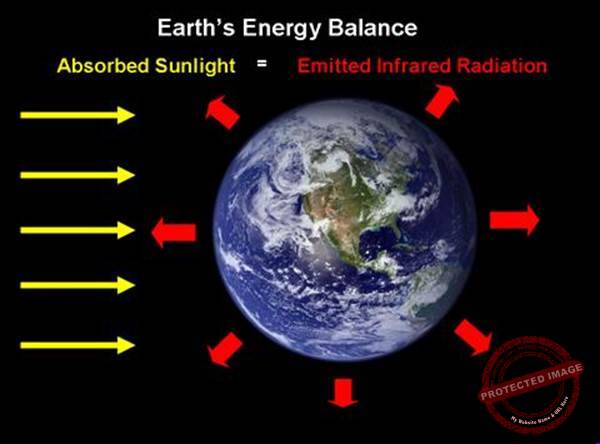
Figure 3.
From Figure 3 above Sunlight hits the earth as nearly perfectly parallel beams. So the sun “sees” earth as a flat disk, as we see the Moon. Therefore the sunlight hitting the earth is Io * π * r2 where r is the earth’s radius and Io is the intensity of sunlight at earth’s distance from the sun which is 1367 watts /meter2 (w/m2).
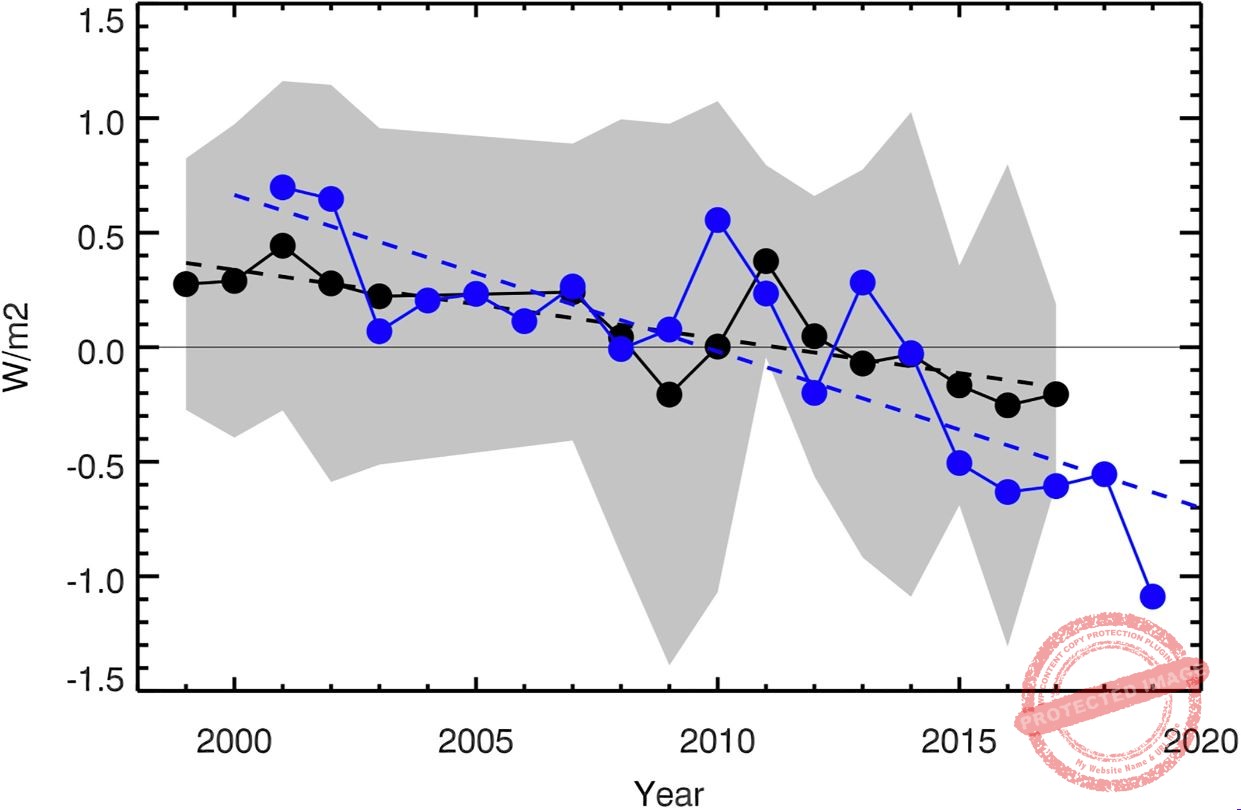
Earthshine annual mean albedo anomalies 1998–2017 expressed as reflected flux in . The error bars are shown as a shaded gray area and the dashed black line shows a linear fit to the Earthshine annual reflected energy flux anomalies. The CERES annual albedo anomalies 2001–2019, also expressed in , are shown in blue. A linear fit to the CERES data (2001–2019) is shown with a blue dashed line. Average error bars for CERES measurements are of the order of 0.2 .
Conclusions
We have reported a two-decade long data set of the Earth’s nearly globally averaged albedo as derived from earthshine observations. Stringent data quality standards were applied to generate monthly and annual means. These vary significantly on monthly, annual, and decadal scales with the net being a gradual decline over the two decades, which accelerated in the most recent years. Remarkably, the inter-annual earthshine anomalies agree well with those from CERES satellite observations, despite their differences in global coverage, underlying assumptions to derive the albedo, and the very different sensitivities to retroflected and wider-angle reflected light.
I am reconstructing this site. MORE TO COME!